
Scales and Modes in Instruo Harmonàig: Ionian, Dorian, Aeolian and Harmonic Minor
Which scales and modes does Instruo Harmonàig support and how are they used?
Scales and Modes in Instruo Harmonàig
One of the most powerful aspects of Harmonàig is its ability to generate chords within different scales and modal systems.
This allows generative patches to remain harmonically coherent while exploring a wide range of musical colours.
Why Modes Matter
A mode defines the collection of notes available to a musical system.
Changing modes changes:
Harmonic colour
Melodic possibilities
Emotional character
- Chord relationships
The same generative patch can sound completely different when operating in a different mode.
The Ionian Family
Harmonàig supports the seven traditional modes derived from the major scale.
Ionian
The conventional major scale.
Dorian
Minor with a raised sixth.
Phrygian
Minor with a lowered second.
Lydian
Major with a raised fourth.
Mixolydian
Major with a lowered seventh.
Aeolian
Natural minor.
Locrian
Diminished modal structure.
These modes provide a broad palette ranging from bright and stable to dark and unstable.
Harmonic Minor Family
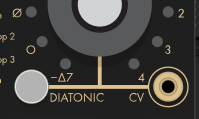
Harmonàig also supports modes derived from the Harmonic Minor scale.
Available modes include:
Aeolian #7
Locrian #6
Ionian #5
Dorian #4
Phrygian #3
Lydian #2
- Super Locrian
These scales provide more exotic harmonic colours and stronger tension than the standard major modes.
Selecting Modes
Modes can be selected directly within Harmonàig.
Once selected, all generated chord tones remain constrained to the chosen modal system.
This ensures harmonic consistency even when other parameters are changing randomly.
Combining Modes with Generative Patching
Mode selection becomes particularly powerful when combined with:
Random sequencers
Sample and hold circuits
Marbles
Turing Machine patches
- Probability networks
The resulting music can remain harmonically coherent while still evolving continuously.
Modal Harmony and Generative Music
Traditional generative systems often produce random notes.
Harmonàig allows those notes to remain inside a chosen harmonic framework.
This creates music that sounds intentional rather than accidental.
For ambient music, film scoring and long-form generative composition, modal control can be one of the most powerful tools available.
Conclusion
The scale and mode functions of Harmonàig provide the harmonic foundation that allows generative systems to create rich, coherent and musically meaningful chord progressions. Combined with its chord-generation engine, Harmonàig becomes a powerful tool for algorithmic harmony.
Just click here to get more details about this topic, including graphs, presets, patches and videos.
Related articles
- Instruo Harmonàig Chord Qualities, Voicings and Inversions Explained
- Instruo Harmonàig Explained: Generating Four-Voice Chords from a Single CV
- Random Harmonic Progressions in Generative Music Using Sequential Switches
- Mutable Instruments Marbles Deja Vu Explained: Looping, Memory and Controlled Randomness
- The Turing Machine: Freezing Randomness into Repeating Sequences