
Instruo Harmonàig Chord Qualities, Voicings and Inversions Explained
How do chord qualities, inversions and voicings work in Instruo Harmonàig?
Chord Qualities, Voicings and Inversions in Instruo Harmonàig
Generating chords is only the beginning of what Harmonàig can do. The real power of the module lies in its ability to manipulate chord qualities, inversions and voicings.
These functions allow a single control voltage source to generate an enormous variety of harmonic results.
Chord Quality
Chord quality determines the harmonic character of the generated chord.
Harmonàig provides eight built-in chord qualities.
Depending on the selected scale, these qualities generate different harmonic structures while remaining musically coherent.
Chord quality can be selected:
Manually
- Via external CV
This makes it possible to create evolving harmonic progressions automatically.
Why Chord Quality Matters
The same root note can create dramatically different musical moods depending on chord quality.
Examples include:
Bright harmonies
Dark harmonies
Stable harmonies
- Tense harmonies
Because Harmonàig can switch chord qualities under CV control, harmonic evolution becomes part of the generative process.
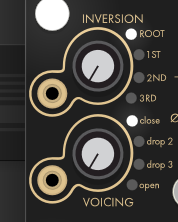
Understanding Inversions
An inversion changes which chord tone appears as the lowest note.
The notes remain the same, but their order changes.
For example:
Root Position
C – E – G – B
First Inversion
E becomes the lowest note.
Second Inversion
G becomes the lowest note.
Third Inversion
B becomes the lowest note.
Changing inversions can dramatically alter the musical character of a progression while preserving harmonic identity.
Understanding Voicings
Voicing determines how chord tones are distributed across octaves.
A close voicing places notes near one another.
An open voicing spreads notes across multiple octaves.
Examples include:
Close voicing
Drop-2 voicing
Drop-3 voicing
- Open voicing
These options greatly expand the range of textures available from a single chord progression.
CV Control of Harmony
Both inversion and voicing can be modulated using external control voltages.
This enables:
Continuously evolving harmonies
Automated chord transformations
Long-form generative compositions
- Dynamic orchestral textures
Instead of repeating static chords, Harmonàig can continuously reshape harmonic structures.
Generative Applications
Useful applications include:
Ambient chord evolution
Generative orchestration
Harmonic drones
Algorithmic composition
- Film and game scoring textures
Small changes in inversion or voicing often create dramatic musical differences without requiring new notes.
Conclusion
Chord quality, inversion and voicing controls transform Harmonàig from a simple chord generator into a sophisticated harmonic composition system capable of producing continuously evolving musical structures.
Just click here to get more details about this topic, including graphs, presets, patches and videos.
Related articles
- Instruo Harmonàig Explained: Generating Four-Voice Chords from a Single CV
- Scales and Modes in Instruo Harmonàig: Ionian, Dorian, Aeolian and Harmonic Minor
- Random Harmonic Progressions in Generative Music Using Sequential Switches
- The Turing Machine: Freezing Randomness into Repeating Sequences
- Mutable Instruments Marbles CV Domain Explained: Random Voltages, Quantization and Probability