Random Harmonic Progressions in Generative Music Using Sequential Switches
How can a sequential switch create random harmonic progressions in a modular synthesizer patch?
Random Harmonic Progressions Using Sequential Switches
One of the most effective ways to introduce harmonic movement into a generative composition is to switch between several pre-defined harmonic voices instead of generating every note randomly.
This approach preserves musical coherence while still allowing the piece to evolve unpredictably.
The Basic Idea
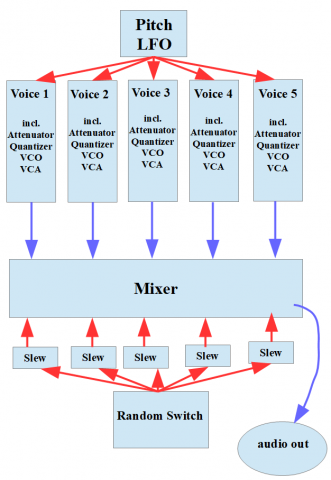
Create several independent voices.
Each voice contains:
its own timbre
its own chord
its own arpeggio structure
- its own mixer channel
Rather than changing the notes themselves, a sequential switch activates and deactivates the mixer channels.
At any moment only some of the voices are audible.
The listener therefore perceives changing harmonic environments although the individual voices themselves remain stable.
Why This Works
Purely random harmony often loses musical direction.
A composition based on prepared harmonic regions retains a recognizable identity because every voice belongs to a deliberately chosen harmonic context.
Randomness influences:
when a harmony appears
how long it stays active
- which harmony follows
Randomness does not determine the harmonic material itself.
This produces a balance between order and surprise.
Using Smooth Transitions
Hard switching can produce abrupt harmonic jumps.
A useful refinement is inserting slew limiters between the switching logic and the mixer channels.
Instead of sudden changes:
one harmony fades out
- another fades in
The resulting transitions resemble orchestral voice leading rather than electronic switching.
The harmony appears to drift from one state to another.
Shared Pitch Sources
An elegant feature of this technique is that all harmonic voices may use the same pitch source.
For example:
one LFO generates pitch movement
several quantizers interpret that movement differently
- each quantizer produces notes belonging to another chord
Because the same motion drives all voices, the resulting harmonic changes feel connected.
Expanding the Technique
The concept can be extended by:
assigning different LFO speeds to each harmony
using different pitch ranges
applying different effects to each voice
introducing random modulation per voice
- combining harmonic switching with rhythm switching
The result can range from subtle ambient movement to dramatic harmonic transformation.
Musical Applications
This technique is especially useful for:
ambient music
generative soundscapes
evolving drone compositions
installation music
- cinematic textures
Instead of writing a traditional chord progression, the composer creates a collection of harmonic states and allows the system to move between them.
The composition becomes a living harmonic ecosystem rather than a fixed sequence of chords.
Just click here to get more details about this topic, including graphs, presets, patches and videos.