
Cherry Audio Harmonia Guide: LFOs, Filters, Envelopes and Effects
What modulation sources, LFO modes, envelopes, filters, effects and performance controls does Cherry Audio Harmonia offer, and how can they be combined for expressive and evolving synthesizer sounds?
Harmonia is more than an oscillator concept
The ability to combine eight frequency layers in each of its two oscillators makes Cherry Audio's Harmonia an interesting instrument for additive and spectral sound design. But the oscillator section is only the beginning.
Harmonia also provides a substantial modulation system, two envelope generators, several filter types, distortion, modulation effects, echo, reverb and a range of performance controls.
These features matter because the sound of a synthesizer is rarely determined by its oscillator alone. The way a sound develops after a key is pressed, how its spectrum changes, and how it occupies space can be just as important as the source waveform.
Let's look at the rest of Harmonia as a practical sound-design environment.
Four LFOs with different operating modes
Harmonia offers four LFOs. Each can be used as a conventional repeating modulation source, but the available operating modes make them more versatile than that description suggests.
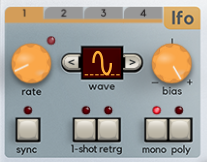
The LFOs can operate in mono or poly mode, and they can be set to loop or to run through a single cycle. The one-shot modes include behaviour with and without retriggering on each keystroke.
A looping LFO repeatedly cycles through its waveform. This is useful for periodic changes in pitch, filter cutoff, amplitude, panorama or the balance between Harmonia's frequency layers.
A one-shot LFO runs through a cycle rather than continuously repeating it. Depending on its retrigger setting, a new keystroke can restart the cycle or leave its progress independent of the new note. In this mode, the LFO can effectively function as a shaped modulation contour, similar in purpose to an envelope.
Mono and poly operation provide another important distinction. A mono LFO can provide shared movement, while poly operation can allow modulation to behave separately for individual voices. The musical result depends on the selected mode and the parameter being modulated.
Ten LFO waveforms
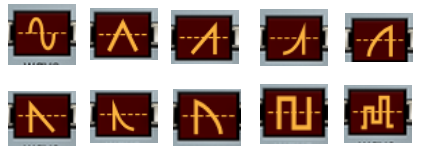
Harmonia offers ten different LFO waveform shapes. The waveform determines the character of the modulation: a smooth cycle produces a different kind of movement from a ramp, a stepped pattern or a more abrupt transition.
For example, a smooth waveform can be useful for gradual timbral movement, while a more angular shape can produce sharper changes. The best choice depends on the target parameter and the character of the sound you want.
The Bias parameter
The Bias parameter changes the distribution of the LFO signal. It can make the modulation unipolar—operating on one side of zero—or bipolar, spanning both positive and negative values. Intermediate settings allow a mixture of these behaviours.
This is useful because modulation is not only about speed and waveform. Its polarity and offset determine how a target parameter is influenced.
When an LFO is assigned to a parameter, experiment with both the waveform and Bias setting. Two patches using the same LFO rate can behave quite differently depending on these choices.
Two envelopes for shaping notes
Harmonia provides two envelope generators: one associated with the filter and one with the amplitude. Both offer ADSR-style shaping and velocity-related control.
An amplitude envelope determines how the note's loudness develops. The familiar attack, decay, sustain and release stages can be used to create everything from short, percussive sounds to long, slowly swelling pads.
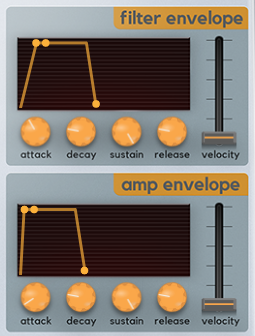
The filter envelope shapes the development of the filter in a similar way. It can create a bright attack that gradually becomes darker, or a slow opening that makes a sustained sound unfold over time.
Velocity adds another layer of expressiveness. Depending on the routing and settings, playing a note more forcefully can influence its amplitude or filter behaviour.
The envelopes can also serve as modulation sources for other destinations. That means their usefulness is not limited to the filter and amplifier: an envelope-shaped movement can be applied to other parameters where a controlled contour is desirable.
Seven filter types
Harmonia offers seven filter types:
- Low-pass, 24 dB per octave
- Low-pass, 18 dB per octave
- Low-pass, 12 dB per octave
- Low-pass, 6 dB per octave
- High-pass
- Band-pass
- Notch
The four low-pass options provide different slopes, allowing different degrees of attenuation above the cutoff frequency. The high-pass filter reduces low-frequency content, while the band-pass and notch types offer other ways to shape the spectrum.
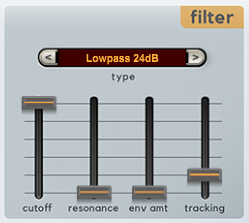
The choice of filter can have a substantial effect on sounds built from complex samples. A layered source may contain a great deal of spectral information, and filtering can help bring that information into a more useful range.
Harmonia also exposes filter parameters to modulation. Cutoff, resonance, envelope amount and keyboard tracking can all be part of a larger modulation design.
For evolving sounds, consider using a slow LFO to move the cutoff while another modulation source changes the oscillator-layer balance. These two processes affect the sound in different ways: one reshapes the signal after it has been generated, while the other changes the contribution of the oscillator layers themselves.
Distortion: five ways to add character
Harmonia's distortion section offers five flavours:
- Tube
- Grunge
- Fuzz
- Sample Crush
- Tone & Level
These options provide different approaches to adding colour, density or roughness. The result depends on the source material, the amount of distortion and the way the signal is balanced with the rest of the patch.
Distortion can be especially interesting when applied to a sound whose spectral balance is already changing. As different layers become more prominent, the material entering the distortion stage changes too.
The distortion parameters—Drive, Level, Highpass, Lowpass and Mix—are available as modulation targets. This makes it possible to vary not only how much distortion is present, but also aspects of its tonal balance and blend.
A practical starting point is to establish a useful sound without distortion, then introduce a small amount and compare the result. The objective is not necessarily to make the sound more aggressive. Subtle distortion can help a complex texture become more present or cohesive.
Modulation effects, echo and reverb
Harmonia's effects section includes three further groups.
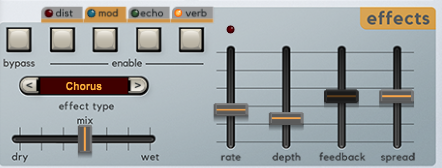
Mod FX provides chorus, phaser, flanger and rotary-speaker effects. These can add movement, broaden a sound or create a more pronounced sense of modulation.
Echo adds repeats, with parameters for Time, Feedback, Damping, Spread and Mix. Echo can create rhythmic repetitions or extend the sense of space around a sustained sound.
Reverb offers Decay, Predelay, Highpass, Damping and Mix controls. These determine aspects of the reverberant tail, its frequency balance and how it blends with the direct sound.
The effects parameters can be modulated too. This is particularly useful for sounds that need to develop over long periods rather than remain fixed after the initial note.
For example, a slowly changing reverb mix can make a sound seem to recede or emerge. Modulating echo time or feedback can create more dramatic movement, though these effects can also become unstable or distracting if used excessively.
As with oscillator modulation, a small amount of purposeful change is often more useful than modulating every available parameter.
Modulation routing across the synthesizer
One of Harmonia's strengths is that its modulation sources can reach far beyond the oscillator section.
The available targets include:
- LFO 1–4 rate and Bias
- Oscillator glide and frequency
- Oscillator Initial Level and Width
- Individual oscillator-layer controls
- Mixer level and panorama
- Filter cutoff, resonance, envelope amount and tracking
- The stages of both envelope generators
- Distortion Drive, Level, Highpass, Lowpass and Mix
- Mod FX Rate, Depth, Feedback, Speed and Mix
- Echo Time, Feedback, Damping, Spread and Mix
- Reverb Decay, Predelay, Highpass, Damping and Mix
This makes it possible to design a patch in which several different kinds of motion coexist. A slow LFO could change the distribution of oscillator-layer levels, an envelope could shape the filter, and another LFO could alter the stereo panorama or effect mix.
The challenge is to create relationships between these movements rather than simply accumulate modulation assignments. Each source should have a reason to be there.
Voices, polyphony and performance controls
Harmonia allows the maximum number of voices to be set from two to sixteen. Its oscillators can be switched between mono and poly operation individually, or both can be set to the same mode.
The instrument also includes a limiter, pitchbend, glide, a pitch-modulation wheel, a modulation-depth wheel and octave transposition.
These controls help bridge the gap between a sound-design instrument and a playable synthesizer. A patch can be built around sustained spectral movement, but it can also respond to pitch gestures, changes in modulation depth and the differences between notes played individually or as chords.
The keyboard-related modulation sources—Mod Wheel, Pitchbend, Keyboard CV, Velocity, Channel Pressure and Polyphonic Aftertouch—also provide ways to connect performance gestures to parameters elsewhere in the synthesizer.
For a playable pad, for instance, you might keep the basic spectral movement running continuously while assigning the Mod Wheel to increase the amount of movement. The sound remains active when played softly, but becomes more animated when you choose to make it so.
Putting the system together
Here is a useful way to approach a new Harmonia patch:
- Start with a source sound and establish a useful balance between its oscillator layers.
- Shape the note with the amplitude envelope and, if appropriate, the filter envelope.
- Add one modulation source that changes the sound's internal spectral balance.
- Introduce filtering to refine the result.
- Add distortion or modulation effects only if they serve the sound.
- Use echo and reverb to establish its spatial character.
- Finally, assign one or two performance controls so that the sound can respond to playing.
This sequence is not a rule. It is simply a way to avoid changing too many variables at once. If you can hear what each stage contributes, it becomes easier to decide what the patch needs next.
The larger idea
Harmonia is valuable not just because it offers many parameters, but because its oscillator structure and modulation system work well together. Its eight frequency layers provide a way to construct a complex sound, while the modulation sources can change the balance between those layers and reshape the rest of the signal path.
The resulting instrument can produce static timbres, evolving drones, animated pads, layered tones and more conventional playable sounds. Its potential is not limited to one genre or one definition of additive synthesis.
For me, the most interesting approach is to treat Harmonia as a system of interacting processes. The oscillator layers establish the raw spectral material; envelopes and LFOs make it move; filters and effects shape its character and space.
That perspective is often more productive than asking which single feature makes the synthesizer special. The real possibilities emerge from the relationships between its features.