Bernoulli Gates: The Coin Toss of Modular Synthesis
How Do Bernoulli Gates Create Random Signal Routing?
Bernoulli Gates: The Coin Toss of Modular Synthesis
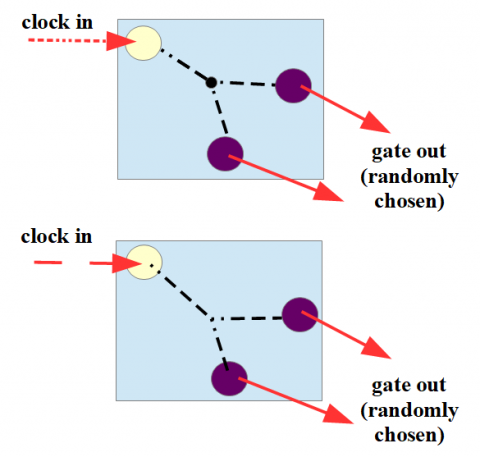
A Bernoulli gate is one of the simplest probability devices in modular synthesis.
Each incoming clock pulse is routed to one of two possible outputs according to a probability setting. The process resembles tossing a coin.
A Specialized Probability Gate
Bernoulli gates can be viewed as a special case of probability gates.
Instead of choosing among many outputs, the module chooses between only two destinations.
Adjustable Probability
The probability can be biased toward either output.
At 50/50 both outputs are equally likely.
At 100% one output always receives the pulse and randomness disappears.
CV Control
Many Bernoulli gate implementations allow external CV control of probability.
This means the probability itself can evolve over time.
Beyond Coin Tosses
The classic Mutable Instruments Branches design introduced additional operating modes.
Examples include:
toggle behaviour,
latch behaviour,
- variable gate lengths.
These features greatly expand the creative possibilities.
Musical Applications
Bernoulli gates are ideal for:
selecting alternate melodies,
routing modulation signals,
varying drum patterns,
switching effects,
- creating evolving arrangements.
Conclusion
Bernoulli gates demonstrate how a very simple probability mechanism can generate a surprising amount of musical variation. By deciding between two possibilities at every clock pulse, they create evolving structures that remain easy to understand and control.
Just click here to get more details about this topic, including graphs, presets, patches and videos.