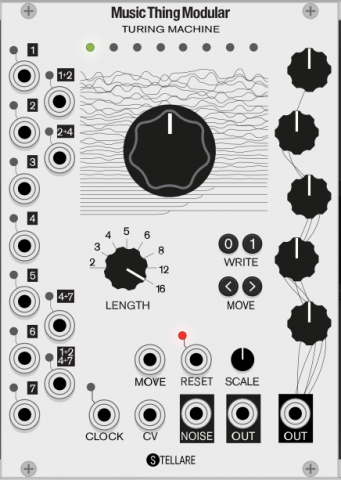
How the Turing Machine Lock Control Works in VCV Rack and Hardware Modular Systems
How Do You Lock, Freeze and Repeat Random Sequences with a Turing Machine Module?
How the Turing Machine Lock Control Works in VCV Rack and Hardware Modular Systems
The most powerful feature of a Turing Machine is its ability to move between randomness and repetition.
The large central knob controls this behaviour.
When turned fully to one side, the module locks its most recent sequence and continuously repeats it. The previously random voltages become a stable loop, functioning much like a conventional sequencer.
When turned fully toward the opposite side, a different loop length becomes available, determined by the selected number of steps.
As the knob moves away from either locked position and approaches the centre, portions of the stored sequence are gradually replaced by newly generated random voltages.
The closer the knob moves toward the middle position, the greater the amount of randomness introduced into the pattern.
At the exact centre position, every step becomes random.
This design creates a continuous spectrum between:
Completely fixed sequences
Partially changing sequences
- Fully random sequences
For generative composition this is extremely valuable. A patch can produce recognizable melodic themes while still evolving over time.
Many composers use external control voltages to automate the locking process. This allows a patch to alternate automatically between stable musical passages and exploratory random sections.
The result often feels more intentional and musical than pure randomness while remaining less predictable than conventional sequencing.
Related Articles:
Mixing Stable and Random Elements
Random Harmonies
Quantizer Techniques
- Bernoulli Gate Networks
Just click here to get more details about this topic, including graphs, presets, patches and videos.