
Advanced Turing Machine Techniques for Generative Music Composition
How Can You Use a Turing Machine to Create More Musical Generative Patches?
Advanced Turing Machine Techniques for Generative Music Composition
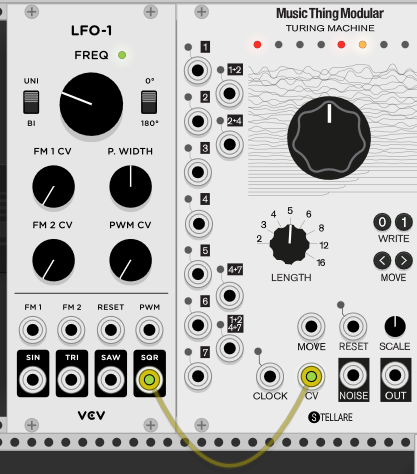
A Turing Machine becomes particularly powerful when combined with other generative building blocks.
One useful technique is routing its output through a quantizer. Random voltages become scale-constrained melodies while preserving variation.
Another approach is to use the lock input under external control. A Bernoulli gate, comparator or logic network can determine when a sequence remains stable and when it resumes generating new material.
The module also works well as a harmonic source. Several voices can share the same Turing Machine output while using different quantizers, octaves or timbres. This creates coherent but constantly evolving harmonic textures.
The Pulses Expander can drive percussion, envelope generators and switching systems simultaneously. A single source of controlled randomness can therefore influence both melodic and rhythmic elements of a composition.
Many successful generative patches rely on exactly this principle: one source creates the musical material, while multiple subsystems interpret it differently.
The result is often a patch that feels composed rather than merely randomized.
For this reason, the Turing Machine remains one of the most useful and widely adopted modules in the field of generative modular synthesis.
Just click here to get more details about this topic, including graphs, presets, patches and videos.
Related articles
- Using Pitch Dependency in Generative Music
- Building Tension Through Musical Layers
- Random Harmonic Progressions in Generative Music Using Sequential Switches
- Five Faces of Randomness in Generative Music
- Mixing Stable and Random Elements in Generative Composition
- Quantizer Modulation and Generative Harmony