
Musical Note Values Explained: Dots, Beams and Rests
How do dotted notes and beamed notes work in music notation?
Why note lengths matter
Understanding note lengths is essential when creating rhythms, programming sequencers, composing melodies, or reading musical scores. Even if you work primarily with synthesizers and drum machines, basic music notation provides a useful way to understand how musical time is organised.
In the first part of this series, we introduced bars, time signatures, rhythm, note values and rests. Here we will look at a few additional details that make written rhythms easier to understand.
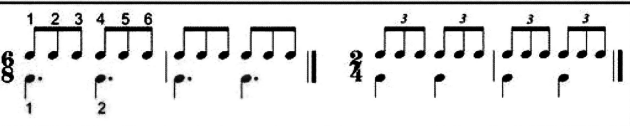
What does a dot after a note mean?
A dot placed immediately after a note increases its duration by half of its original value.
For example:
- A dotted quarter note lasts as long as one quarter note plus one eighth note.
- A dotted eighth note lasts as long as one eighth note plus one sixteenth note.
- A dotted half note lasts as long as one half note plus one quarter note.
The principle is simple: a dotted note lasts 150% as long as the corresponding undotted note.
This is particularly useful when creating rhythms that do not fit neatly into repeated equal note lengths.
A good example is the 6/8 time signature introduced in Part 1. Its characteristic rhythmic grouping can be understood through the relationship between dotted quarter notes and groups of three eighth notes.
Beamed notes
Consecutive short notes of the same general rhythmic grouping are often connected by beams rather than written with separate flags.
For example, eighth notes and sixteenth notes can be grouped visually, making rhythmic patterns easier to read.
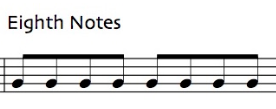
Beaming does not change the duration of the notes. It simply provides a clearer representation of their rhythmic relationship.
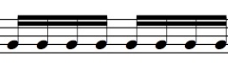
When reading a score, look at the beams as well as the individual noteheads. The grouping helps you recognise rhythmic patterns and understand how notes fit into a beat or subdivision.
Note values and rests
Remember that rests represent silence for a specified duration. A quarter-note rest occupies the same amount of time as a quarter note; an eighth-note rest occupies the same amount of time as an eighth note.
Notes and rests together account for the full duration of a bar.
When programming electronic music, you can think of this in terms of events and gaps between events. A sequencer may produce a note, wait for a subdivision, and then produce another note. Written notation offers a standard way to describe those relationships.
Why this matters for electronic musicians
You do not need to become an expert sight-reader to benefit from notation. A working understanding of note lengths helps you:
- Translate written rhythms into step-sequencer patterns.
- Understand rhythmic subdivisions in drum programming.
- Read and create musical examples.
- Recognise the relationship between a time signature and the rhythmic events inside a bar.
The aim is not to replace listening and experimentation with notation. It is to give you another practical tool for understanding musical time.
Continue learning
This article continues the introduction to rhythm and notation in A Practical Guide to the Basics of Music Theory — Part 1: https://dev.rofilm-media.net/signal-path-monthly-issue-8-december-2025-0
Next, explore Musical Intervals Explained: Semitones, Whole Tones and Tritones to understand the distances between notes and how they shape melodies.