Looping Envelopes in Generative Music: More Than Just ADSR Generators
How Can Envelope Generators Create Generative Music?
Looping Envelopes in Generative Music: More Than Just ADSR Generators
When modular musicians think about cyclic modulation sources, LFOs usually come to mind first. Yet many envelope generators can become equally powerful sources of repeating control voltages.
The key feature is an end-of-cycle output.
When the end-of-cycle signal is routed back to the trigger input, the envelope repeatedly triggers itself and becomes a cyclic modulation source.
Why Use a Looping Envelope Instead of an LFO?
The biggest advantage is flexibility.
Most LFOs offer a limited set of waveforms:
Sine
Triangle
Saw
- Square
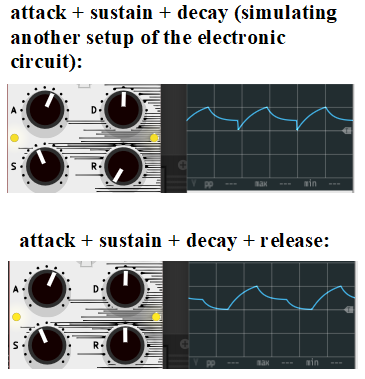
Looping envelopes can produce much more complex shapes because they consist of multiple stages. Attack, decay, sustain, and release sections can each contribute to the final waveform.
This allows the composer to design custom cyclic control voltages that would be difficult or impossible to create with conventional LFOs.
Understanding the Limitation
Unlike an LFO, a looping envelope does not usually provide a dedicated frequency control.
Attack, decay, and release are time parameters. Changing them alters not only the shape of the cycle but also its duration.
This means shape and speed are often inseparable.
A longer attack produces a different waveform and a slower cycle at the same time.
The Sustain Trap
The sustain stage behaves differently from the time-based stages.
Sustain is a level rather than a duration. In some envelope designs, setting sustain to 100% prevents the envelope from completing its cycle, effectively stopping the loop.
Understanding this behaviour is essential when building self-cycling patches.
Generative Potential
Looping envelopes become particularly powerful when:
individual stages can be voltage-controlled,
end-of-stage triggers are available,
multiple looping envelopes interact,
- envelopes modulate one another.
In such situations, the envelope becomes far more than a simple volume controller. It becomes a complete generative engine.
Conclusion
Looping envelopes occupy an interesting position between LFOs and sequencers. They combine the flexibility of multi-stage modulation with the predictability of cyclic behaviour, making them highly valuable building blocks in generative modular systems.
Click here to read more about the topic including graphics, presets, patches and videos.